
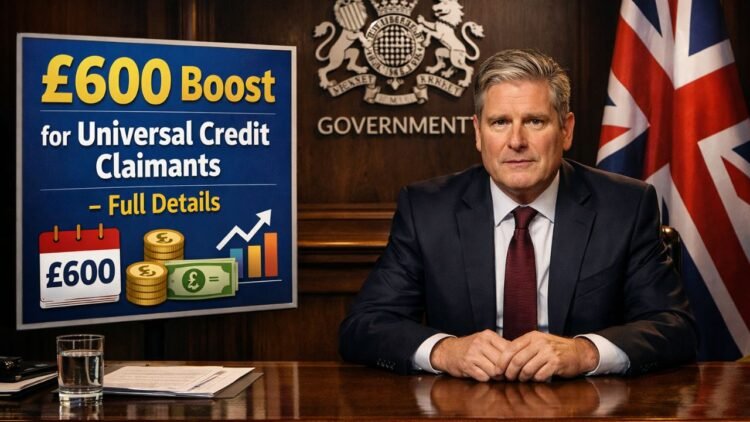
Millions of people across the United Kingdom are closely watching new announcements about financial support from the government. With the cost of living still affecting household budgets, many families rely on benefits to help cover essential expenses such as food, rent, and energy bills.
Recently, discussions around a £600 boost for Universal Credit claimants have gained significant attention. Many people are asking whether this payment will be introduced, who qualifies, and when the money could arrive.
Payment Details

The proposed £600 boost for Universal Credit claimants is being discussed as part of wider benefit adjustments linked to inflation and cost-of-living support.
The DWP payment increase 2026 focuses on ensuring that benefit payments keep up with rising living costs across the UK.
Key Details of the Proposed Payment
| Payment Feature | Details |
|---|---|
| Payment Amount | Up to £600 |
| Target Group | Universal Credit claimants and some low-income households |
| Administered By | Department for Work and Pensions (DWP) |
| Payment Type | Possible cost-of-living support |
| Payment Method | Direct bank transfer through existing benefit accounts |
| Frequency | Expected as one-off or staged payments |
For many households, a Universal Credit payment increase like this could help cover essential costs such as:
- Rent or mortgage payments
- Food and groceries
- Utility bills
- Transportation costs

Because Universal Credit supports millions of claimants, any UK government payment targeting this group could have a major impact.
Eligibility Criteria
Not everyone receiving benefits will automatically qualify for the proposed payment. The government typically sets eligibility rules to ensure support reaches those most in need.
Possible Eligibility Requirements
To qualify, claimants may need to:
- Receive Universal Credit
- Have an active claim during a specific qualifying period
- Meet income and savings limits
- Live in the United Kingdom
- Be receiving other qualifying benefits
Benefits That May Qualify
In some cases, other benefit recipients may also receive support under broader UK government payment programs.
These may include:
- Universal Credit
- Pension Credit
- Income Support
- Income-based Jobseeker’s Allowance
- Income-related Employment and Support Allowance
Who May Receive Priority
- Families with children
- Disabled individuals
- Pensioners on low income
- People with high energy costs
Payment Dates
Possible Payment Timeline
| Stage | Expected Period |
|---|---|
| Government announcement | Early 2026 |
| Eligibility check | Shortly after announcement |
| First payments issued | Mid-2026 |
| Final payment stages | Later in 2026 |
How Payments Are Delivered
Payments are normally sent:
- Directly to the claimant’s bank account
- Through the existing Universal Credit payment system
- Without requiring a separate application
Because the system already contains claimant details, the DWP payment dates can often be processed quickly once approval is given.
How to Claim the Payment
One of the most positive aspects of many government support schemes is that claimants often do not need to apply separately.
Automatic Payments
If the payment is approved, eligible claimants would likely receive the money automatically.
This means:
- No additional forms
- No new application
- No need to contact the DWP
Instead, payments would be processed using the same information already linked to a claimant’s Universal Credit account.
Steps Claimants Should Take
Although the payment may be automatic, it is still important to ensure your details are correct.
Claimants should:
- Check their Universal Credit account online
- Ensure bank details are correct
- Confirm address and personal details are up to date
- Monitor official DWP payment dates announcements
These simple checks can help prevent delays in receiving a UK government payment.
Watch Out for Scams
Whenever major benefit payments are announced, scammers sometimes attempt to exploit claimants.
The DWP warns people to avoid:
- Emails asking for bank details
- Messages claiming you must pay a fee
- Fake government websites
Official payments related to the benefit payment increase UK never require fees or private financial information.
Latest Government Update
Government officials continue to review benefit levels and cost-of-living support for 2026.
The DWP payment increase 2026 forms part of a broader effort to help households manage rising expenses.
These measures included:
- Cost-of-living payments
- Energy bill support
- Benefit increases linked to inflation
The latest Universal Credit payment increase discussions reflect ongoing pressure from economists and advocacy groups.
Why the Payment Is Being Considered
Several economic factors have increased pressure on household finances:
- Rising energy prices
- Higher food costs
- Increasing rent levels
- Inflation affecting everyday spending
The government’s goal with the benefit payment increase UK is to ensure that benefits continue to provide meaningful support.
Conclusion
Financial support remains a crucial lifeline for millions of people across the UK. With living costs still affecting many households, discussions about the £600 boost for Universal Credit claimants have generated significant interest.
The proposed payment is linked to the broader DWP payment increase 2026, which aims to ensure benefits keep pace with rising living costs.
FAQs
Will everyone on Universal Credit receive the £600 payment?
Not necessarily. Eligibility may depend on income levels, qualifying benefits, and the official criteria set by the government.
Do I need to apply for the payment?
Most likely no. Payments linked to the DWP payment increase 2026 are usually issued automatically to eligible claimants.
When will the payment be made?
Exact DWP payment dates have not yet been confirmed. Payments could begin sometime during 2026 if the scheme is approved.