
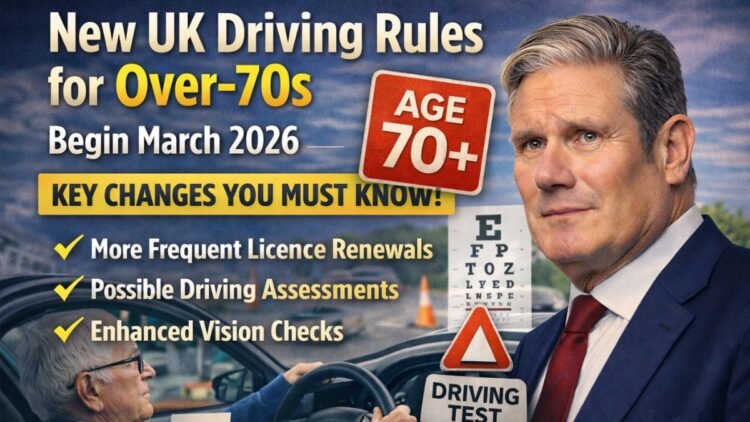
For decades, driving has symbolised independence for older adults in the United Kingdom. However, major changes to driving licence rules for motorists aged 70 and above are set to take effect from March 2026, marking a shift from the traditional “self-declaration” system toward stricter safety checks.
The reforms are being introduced by the Driver and Vehicle Licensing Agency (DVLA) and the UK government as part of a broader road-safety strategy aimed at reducing serious road accidents and fatalities.

In 2024 alone, 1,633 people were killed and nearly 28,000 were seriously injured in road accidents across the UK, prompting authorities to strengthen licensing rules and health checks for drivers.
If you are approaching your 70th birthday—or already over 70—these changes will affect how you renew your licence, prove medical fitness, and maintain your driving privileges.
Why the UK Is Changing Driving Rules for Over-70s
Historically, drivers turning 70 simply renewed their licence and self-certified that they were medically fit to drive. Critics argued this system relied too heavily on honesty and allowed some drivers with deteriorating vision or medical conditions to remain on the road.

Recent investigations revealed millions of motorists may have eyesight below the legal standard, highlighting the need for stronger checks.
As a result, the government is introducing new verification requirements, especially around eyesight and medical fitness, to improve road safety while still allowing seniors to retain independence.
Key UK Driving Rule Changes for Over-70s (March 2026)
Below are the most important updates that older drivers must know.
1. Mandatory Eyesight Checks During Licence Renewal
The biggest change involves mandatory vision verification.
Currently, drivers only confirm they can read a number plate from 20 metres away, but under the new proposals:
- Drivers 70+ may need proof of a recent eyesight test when renewing their licence.
- Vision tests could be required every three years, matching the renewal cycle.
- Drivers must meet the legal standard of 6/12 visual acuity on the Snellen scale with both eyes (with glasses or contacts if needed).
Drivers who fail the eyesight requirement could lose their licence until the issue is corrected, such as through updated glasses or eye surgery.
2. End of the “Self-Declaration Only” System
The old honour-based system is gradually being replaced with evidence-based verification.
Authorities are exploring:
- Eye test certificates
- Random health checks
- Possible cognitive assessments for older drivers
These reforms aim to ensure every driver is physically capable of reacting to modern traffic conditions.
Driving Licence Renewal Rules After Age 70
Many drivers believe their licence lasts forever—but that’s not the case.
Once you reach 70:
- Your licence expires automatically
- You must renew every three years
- Renewal is free when completed online
The DVLA usually sends a D46P reminder form about 90 days before expiry.
Important:
Driving with an expired licence means your car insurance becomes invalid, which could lead to fines or vehicle seizure.
Eligibility & Renewal Requirements for Drivers Over 70
The following table summarises the new requirements and eligibility criteria.
| Category | Requirement |
|---|---|
| Minimum Age for Renewal | 70 years |
| Licence Validity | 3 years after age 70 |
| Renewal Fee | Free via GOV.UK |
| Vision Requirement | Must read number plate from 20m |
| Medical Declaration | Mandatory disclosure of health conditions |
| Eye Test Evidence | May be required during renewal |
| Renewal Method | Online (recommended) or by post |
Medical Conditions That Must Be Reported Immediately
Under the new guidelines, drivers must inform the DVLA as soon as a medical condition is diagnosed, not just during licence renewal.
Conditions that must be reported include:
- Dementia or cognitive impairment
- Parkinson’s disease or epilepsy
- Stroke or serious heart conditions
- Insulin-treated diabetes
- Severe sleep apnoea
Failing to report a condition could lead to fines of up to £1,000 and possible licence cancellation if discovered after an accident.
Stricter Rules for Minibus and Lorry Licences
Drivers who hold C1 (medium vehicles) or D1 (minibus) entitlements face additional requirements.
To keep these licences after age 70:
- A D4 medical form must be completed by a GP.
- Full health assessments are required.
Without this examination, those categories may be removed during renewal, leaving only standard car or motorcycle permissions.
Online Licence Renewal – Faster and Free
The DVLA is encouraging older drivers to use the official GOV.UK website.
Online renewal benefits
- Completely free
- Licence usually arrives within one week
- Digital medical questionnaire simplifies health checks
Drivers should avoid third-party websites that charge £40–£80 processing fees, as renewals through GOV.UK cost nothing.
The March 2026 UK driving rule changes for over-70s represent one of the most significant updates in decades. By introducing mandatory eyesight checks, stricter health reporting, and improved licence renewal systems, the government aims to enhance road safety while helping seniors maintain independence.
Drivers who stay proactive—by keeping their vision tested, health conditions reported, and licences renewed on time—can continue enjoying the freedom of the road safely for years to come.
FAQs
Do drivers over 70 have to retake a driving test in the UK?
No. Drivers over 70 do not need to retake the standard driving test. However, they must renew their licence every three years and may be required to provide eyesight or medical evidence.
Is the eyesight test mandatory for all drivers over 70 in 2026?
The UK government is introducing mandatory eyesight verification during licence renewals, which may require proof of a recent eye examination every three years.
What happens if my licence expires after age 70?
Driving with an expired licence is illegal and invalidates your car insurance, which could result in fines, penalty points, or vehicle seizure.